
Frequently Asked Questions
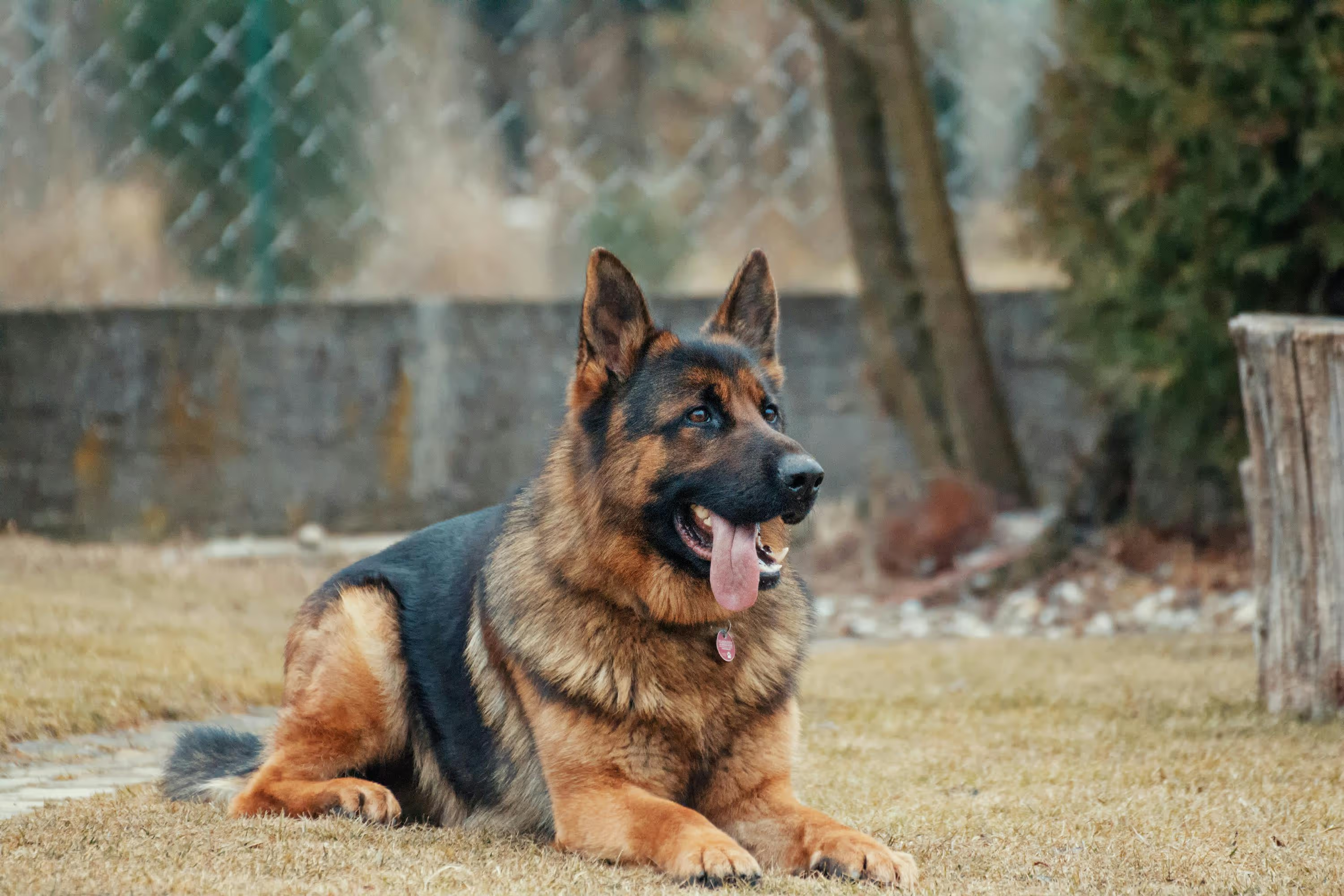
Yes. Aggression often grows from the dog’s fear. Your dog needs training to build confidence, learn what you consider ‘appropriate’ behavior and recognize that you are in charge, and you set the priorities. Without training, the aggression will get worse. Consider our Aggressive Dog Program.
Yes. We welcome others. You are responsible for your children’s safety and behavior. It is a good idea for other members of the family to teach the dog to work for them, too. Often, our one-on-one coaching sessions can help others learn training skills with the dog.
Use the “Register Online” tab for class registration, private lessons or Membership. If you want to discuss your priorities and how we might help achieve them before you register, use the “Contact Us’ tab to send a note or call. You and your dog(s) may begin at any time that fits your schedule. In some cases, it is not necessary to wait for the start of a new eight-week session.
The average throughout the year is about 10 in the beginning classes; however, the number varies week to week since one can attend any of the in-person or online sections, and it varies by times of the year, with the January and September sessions often the busiest.
Severe weather conditions (thunderstorms, winter ice, snow, or cold) may cause us to cancel a class for a day or more. We add that time to the end of the session.
In case of a human emergency, we call 911 for help. In case of a canine emergency and when one cannot contact one’s own vet, we contact the 24-hour emergency service now provided by Horton Discovery Service.
We offer classes nearly year-round in eight-week sessions primarily on weekday evenings and Saturdays. Some of the specialty classes are offered on an as-needed or as-requested basis. See the school schedule for the regularly offered classes. If you do not find the class you want on the schedule, ask us about the possibility of offering it to you.
The tuition of $285 covers unlimited continuous enrollment in Puppy Kindergarten or Level 1 classes and in the graduation class – Level 1+. Access to advanced classes and other activities is available through annual memberships in our school. We have four annual membership types – Columbia area ($875), Long-distance — for those living more than 50 miles from the training center ($785), Columbia area senior ($735), and Long-distance Senior — for persons 65 or older ($645). More about the Member fees.
Team members create dance routines with their dogs in the tradition of free-style obedience, develop tricks and unusual moves choreographed to music. Team members perform frequently throughout central Missouri at fairs and festivals, and for school children and senior citizen venues. They often combine performances with therapy visits at those venues. Here is an example.
Yes. Our scheduled classes – beginning, advanced, and specialty are delivered as group work. In addition, for those enrolled in the group work, we offer one-on-one coaching sessions at no additional cost to help with specific training issues.
Yes, in two formats. We offer no additional-cost private lessons (in-person or online) for members and those enrolled in our group classes. For others, we offer private lessons or problem-solving consultations. The fee for those sessions is $90 per hour.
Our physical address is 325 E Dripping Springs Road, Columbia, Missouri, 65202. That is off US Highway 63, about nine miles north of its intersection with I-70. Our online address is https://dogschooling.com/.
Membership is an annual commitment to training (like a gym membership). With the membership, you may participate in any of our classes that fit your priority and use our facilities, including our dog parks for play and practice outside of the classes. Membership includes all the dogs and people in your immediate family.
We have four annual membership types: Columbia area ($875), Long-distance for those living more than 50 miles from the training center ($785), Columbia area senior ($735), and Long-distance Senior for persons 65 or older ($645).
Bring your puppy to class as early as possible – when your vet says the puppy can attend, given the puppy’s vaccination routine, usually 7 to 10 weeks.
You will be teaching them to pay attention and follow through on your commands. Our Kindergarten will also help curb common puppy problems – biting, jumping, etc. Kindergarten includes lots of socialization with other puppies and other people in the class. It builds the puppy’s confidence. Kindergarten should be fun for the puppy and you. Here’s a list of training topics.
Yes. You are welcome to any of our classes. It may be helpful to talk with us to match your priorities with an appropriate class and to ensure someone will meet you to answer questions you may have.
Yes. We are happy to schedule an appointment to meet your dog, learn more about your priorities, and have your dog see the school facility.
Yes, we have air conditioning for the warm parts of the year and heat for the cold parts.
No. However, you may stay in Puppy Kindergarten or Level 1 for as long as it takes for your dog to learn the material, and you may go on to the graduation class (Level 1+) and stay in it for as long as you want to. From our end, we will work for you at these levels as long as you continue to participate. Our refund policy includes return of some of the class or Membership fee depending on time of your refund request.
Yes. We do not keep credit card information, and we only share other information (name, address, etc.) as required by law.
We require the shot list our veterinarian has recommended for us. In some cases, your vet may recommend changes in that list. We accept a record of the shots your vet has given.
For class registration, we refund the full registration tuition for cancellations before the session of classes for which the registration was made has begun. When the cancellation occurs during the first two weeks of a session, we provide a refund of the registration tuition minus the equivalent of a private lesson: currently $90. When we receive the cancellation request after the second week of a session, except for illness or incapacity of the handler or dog, there is no refund. We have similar policies for private lessons and Membership. Here is a link to the policy.
We accept cards, cash, or checks.
Yes. There are two elements in service dog training: One is the foundation training in basic obedience, so the dog learns and values working with and for you. The second are the specific tasks the dog must learn to do for you. We can often help with both; however, in some cases, the specific tasks (like blood work) may be so specific that you will need to find specialized training resources. We may be able to help with that search.
Yes. The therapy dog service is a major part of what we do in our school. We begin training for the certifications in the primary obedience classes (Puppy Kindergarten, Level 1, and Level 1+) – training for the Canine Good Citizen test, which is the foundation for the therapy dog certification. The more focused prep for that work is in our Therapy/Service Dog prep class, which is available through Membership
Yes. We have deaf dogs in beginning and advanced training. Since dogs’ primary communication is with body gestures – tail wagging, lip-licking, staring, leg lifting, turning away, etc. – they can learn from us with gestures we use. See this puppy work after five months of training.
Yes – within the context of the training and facilities we offer. For example, we do not offer hunting and other gun-work training. For the classes we offer, we invite students and members to schedule one-on-one coaching sessions to deal with specific issues.
Yes. We begin training for the CGC test in Puppy Kindergarten, Level 1, and Level 1+. The advanced preparation is in our Therapy/Service Dog class, which is available through Membership.
No. We substitute the verbal cue – ‘Yes’ for the click; however, you are welcome to use your clicker. The click or the ‘yes’ is an instant signal to the dog that the dog did the behavior you wanted.
How long? – It might be as short as a private lesson or two or an 8-week session or as long as a year or more. Most of that time depends on you, your training skills, your time on training, your training goals, etc. Some are based on the dog’s natural learning capability, but we find that the time it takes is mostly on us (the human end of the leash). From our end, we will work for you at these levels as long as you continue to participate.
We have been providing training services for about fifty years. We opened our current facility in 1992. Learn more about us.
No. However, crates can be valuable for the life of your dog. They can serve as the dog’s den – a place the dog can go to be safe and relax. A crate can be a safe place to curtail the dog from wandering into trouble while you sleep or while you are away. The crate can help with potty training.
For therapy dogs, you and your dog are trained as a team to provide services to others. For example, provide comforting attention to persons traumatized by fire, weather, health issues. For service dogs, your dog is trained to provide specific services for people with disabilities, for example, steadying you when walking, picking up things, opening gates, and alerting you to health changes. We offer the foundation training for both specialities.
Our primary approach to dealing with dog behavior we don’t want is to teach the dog what we do want. Rather than waiting until a dog has done what we don’t want and then correcting it, we should identify the trigger of that behavior and reward the dog for doing what we want in the presence of the trigger. Our ‘method’ is using the tools of a teacher to help the dog learn what we want – clear instruction, patience, consistency, fun, and reward.